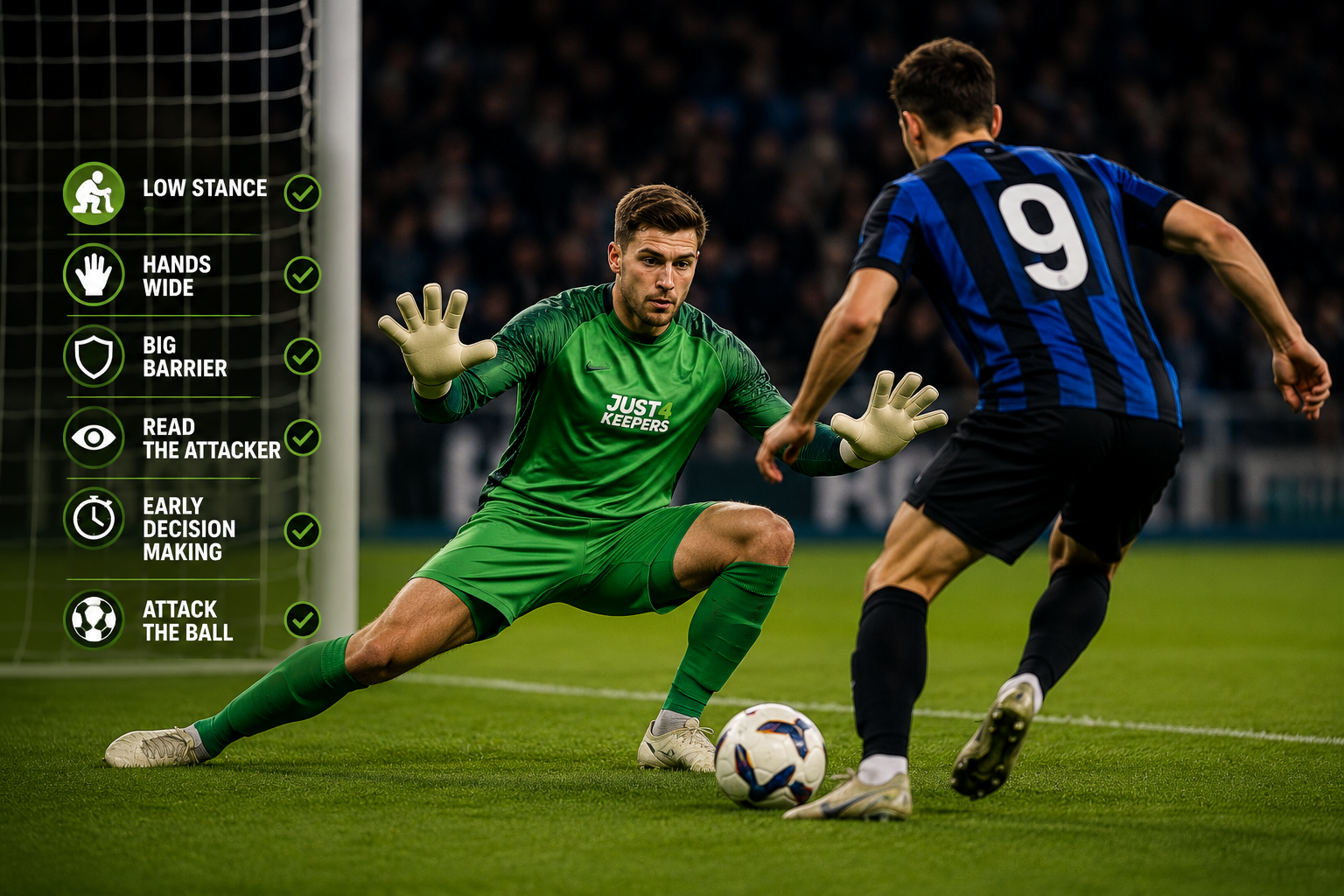
The most important factor is to ensure that you gain possession of the ball and not your opponent, otherwise you will recieve a booking and worse still, be sent off. Your hand shapes and positioning of hands are vital because they are needed to block the ball if you are diving head first. Keepers such as Pepe Reina drop down making a cove with the legs but Pepe’s hands are kept wide making himself a large barrier, whilst Robert Green sits down on one leg with his other leg stretched wide and his hands up. The reason for this is because many good forwards today are trying to lift the ball over the keeper. so the keeper has to counteract that by splaying hands up and wide. It is also crucial to now when to stay on your feet and when to go to ground.
It is necessary when watchin the attacker to adopt a low stance wit the arms down by the side of the feet and to watch any little signs that will determine when you pounce on the attacker. These will include when the attacker has difficulty with a pass that is either to soft or too hard or takes a poor first touch. All of these give the keeper an opportunity to attack the ball. Saving in these situations can be with the feet as well as the hands, especially where it is not possible to get the hand to the ball.
Where an opponent is coming at you quickly you do not want to be coming out too quickly yourself, so you have to advance down the line cautiously, slowly and being aware of what may happen. If the opponent has got the ball stuck under his feet or beyond playing distance that is your opportunity to cover the ground quickly. Also if the the keeper shhould look at the angle of the run to see if he can turn the opponent away from the goal in an area of the keepers choice and in effect saying to the opponent ‘that’s the side I want you to go’.
Early decision making is paramount, so if the ball is played through and is around the 18 yard box the first thing the keeper has to expect is a shot so he has to be fast enough down the line to intercept the through ball but not too far so as to be vulnerable to a chip over him or her. if the decision is to go for the ball it must be done quickly without hesitation and leading with the keeper’s hands so that he can quickly bring the ball into his body.
Other noticeable decisions include assessing whether the keeper is going to get the ball first or at the same time as their opponent. If he/she thinks they can get there first without any hesitation. if he/she feels it is likely to be at the same time the keeper must present a barrier by getting his hands as close to the ball as possible to effect a block. If the opponent has the ball at his/her feet coming at the keeper a more forthright block is needed, hands, body or legs where possible.